Space Talk traces seven decades of how outer space has been framed, addressed, and imagined — examining both how space is discussed in media and politics, and how humanity has attempted to speak into space itself.
Live site ↗Outer space is a domain as symbolic as it is physical. From the Cold War space race to the rise of commercial spaceflight, the material history of space exploration has unfolded alongside a parallel history of narrative: how space has been framed, addressed, and imagined.
Space Talk maps that narrative history across seven decades through two parallel records: one of talking about space and one of talking to space. It examines outer space as a cultural and political object, asking what its construction reveals about the societies that looked up at it.
Two corpora were assembled to trace how outer space has been publicly constructed across U.S. media and political discourse.
For news, 6,442 headlines were collected from The New York Times (1950–2024) using the NYT Article Search API. For politics, 1,408 excerpts were drawn from U.S. presidential communications via the American Presidency Project (1960–2024), extracting only passages where space-related terms appeared.
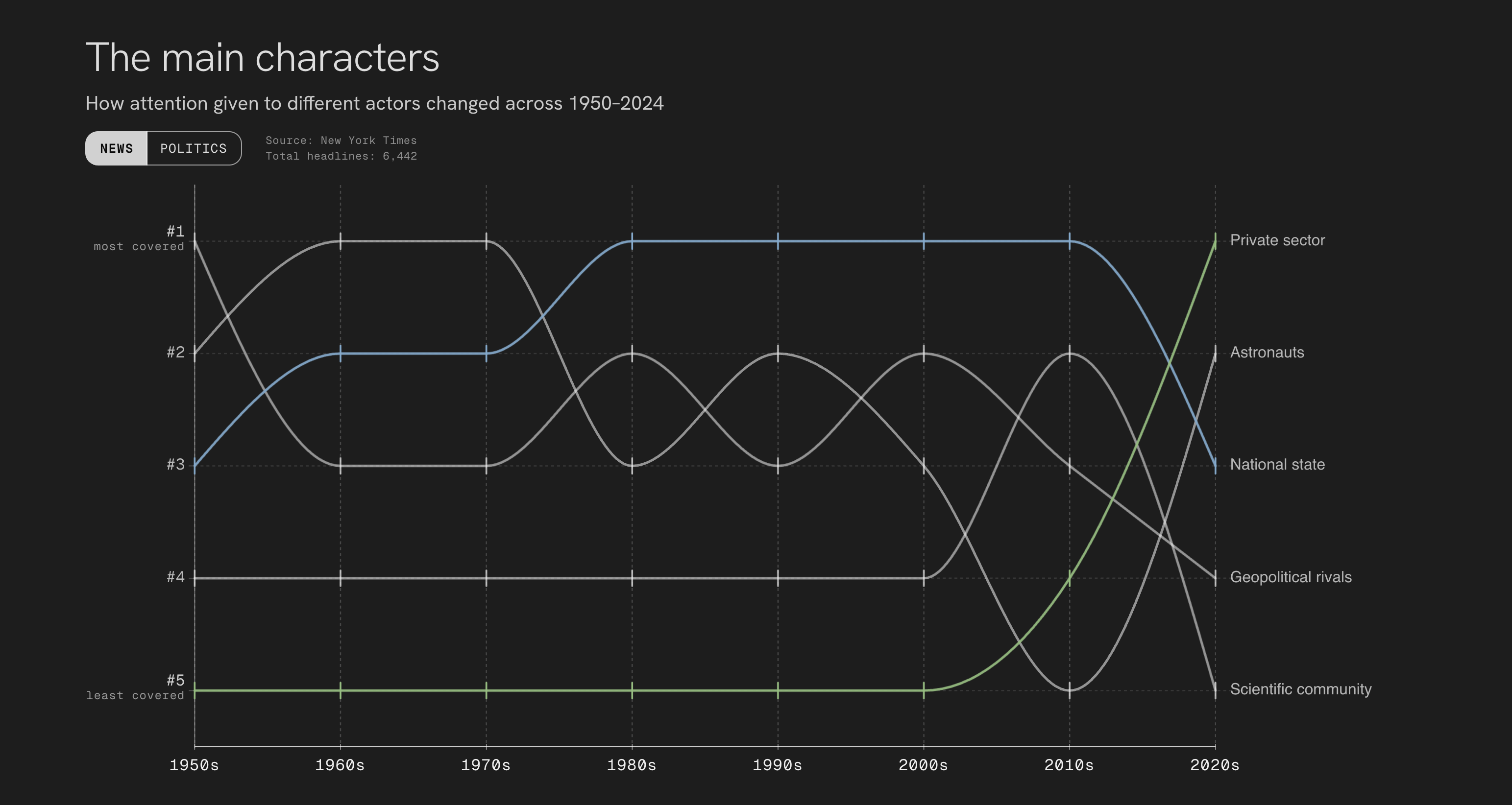
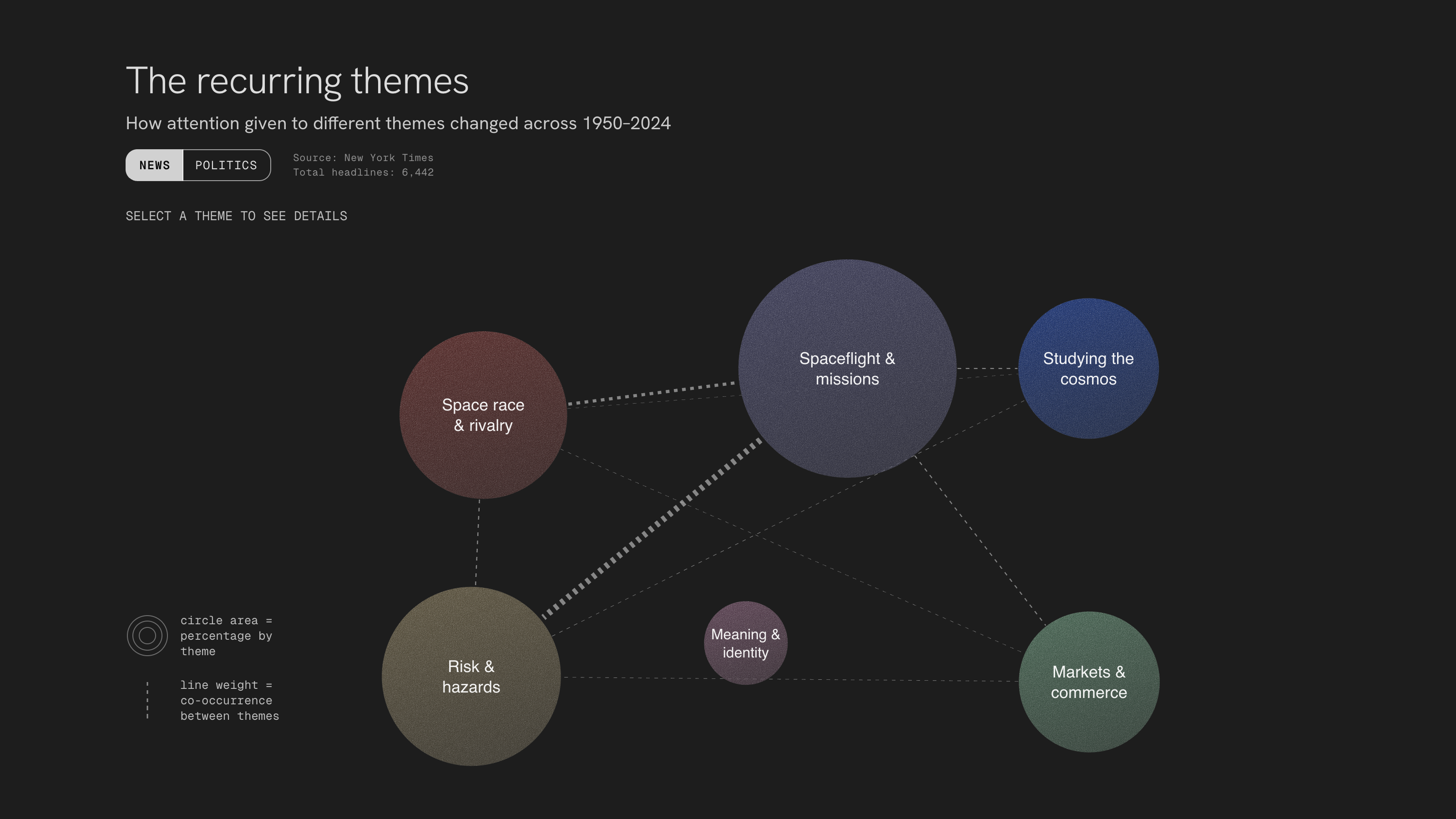
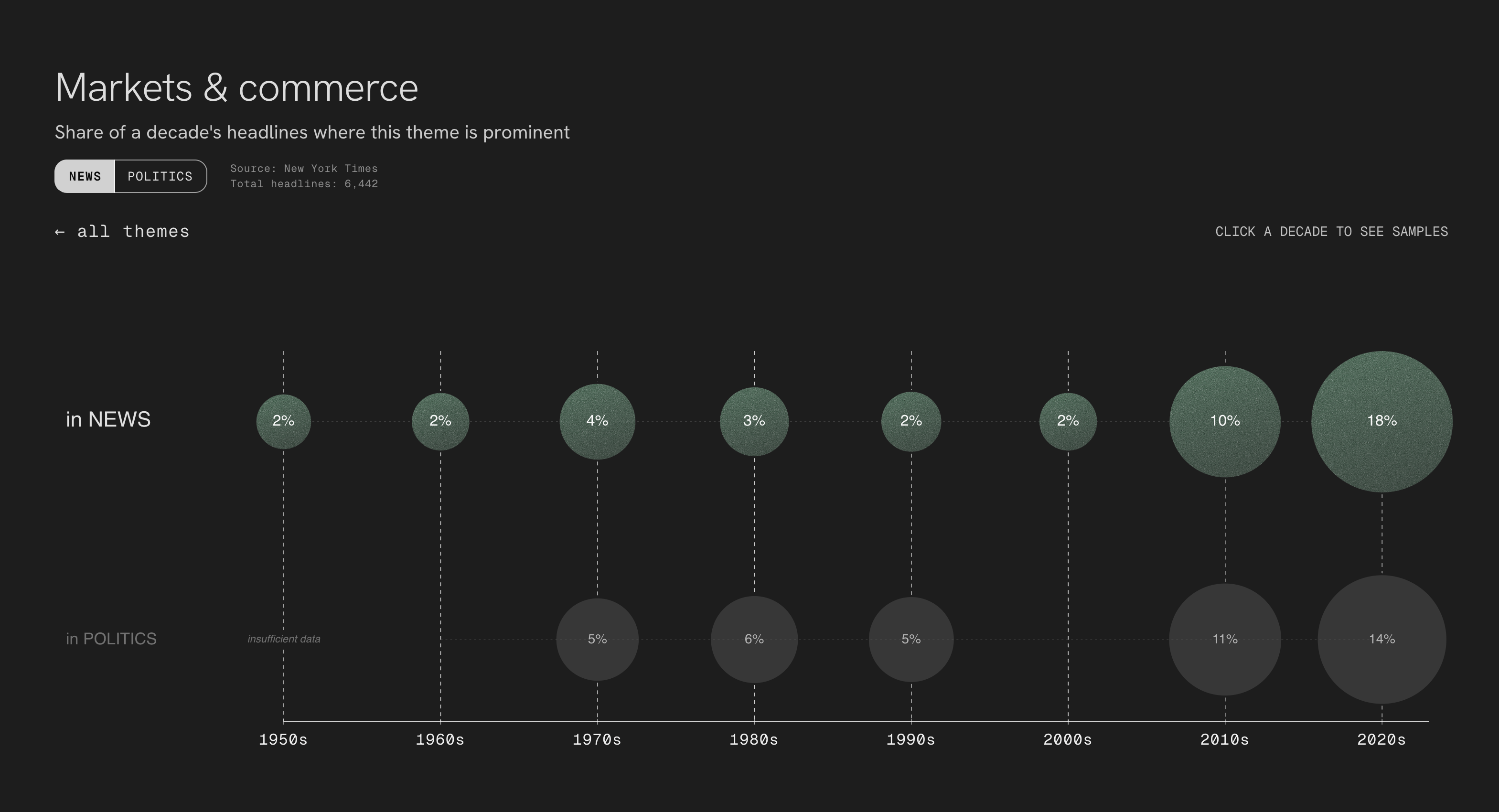
Texts were embedded using a sentence-transformer model (nomic-embed-text-v1.5) and compared to a set of thematic frames and actor categories to measure semantic similarity. Each document was then normalized relative to its distribution of scores, highlighting which themes and actors stand out within it.
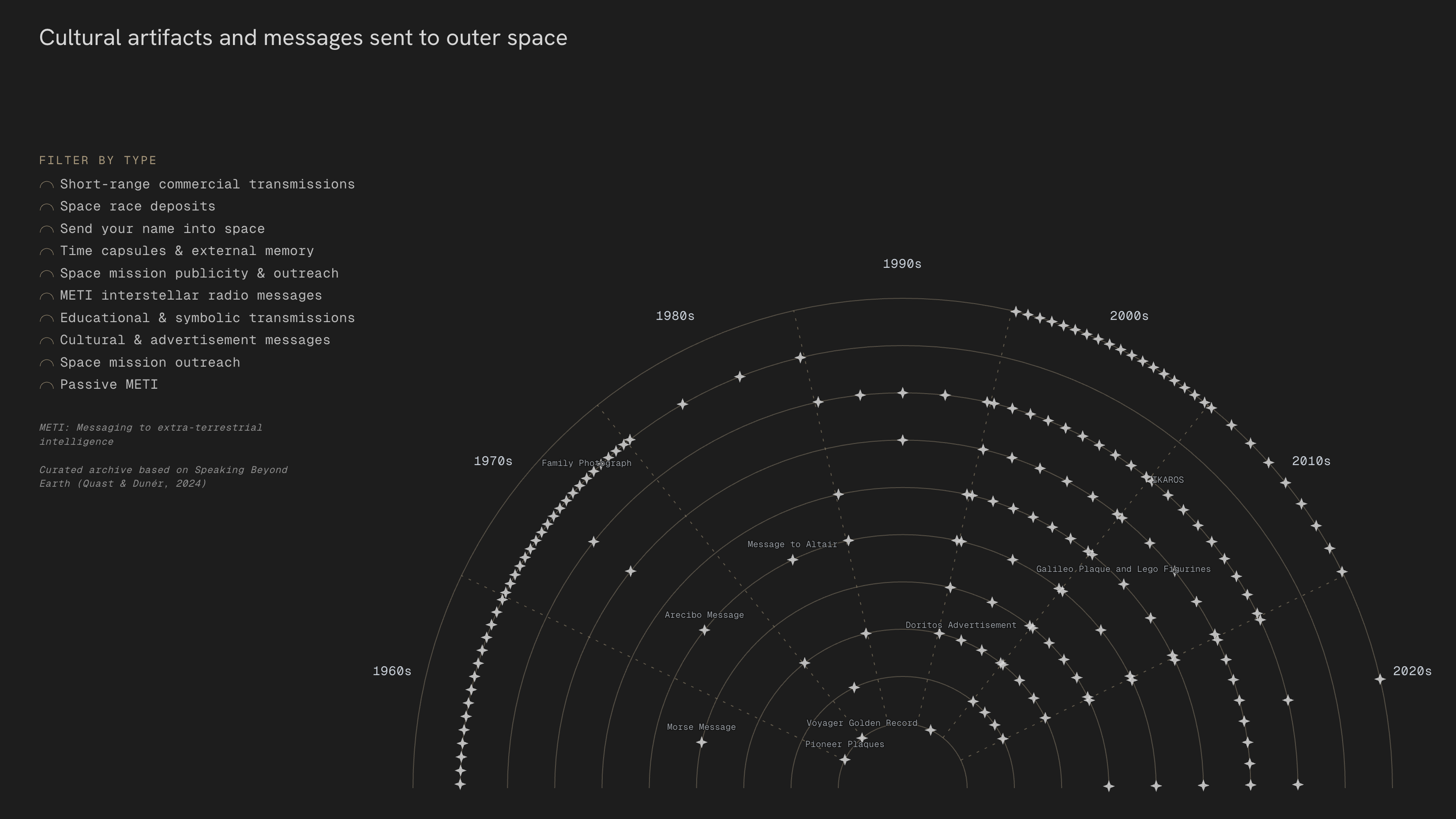
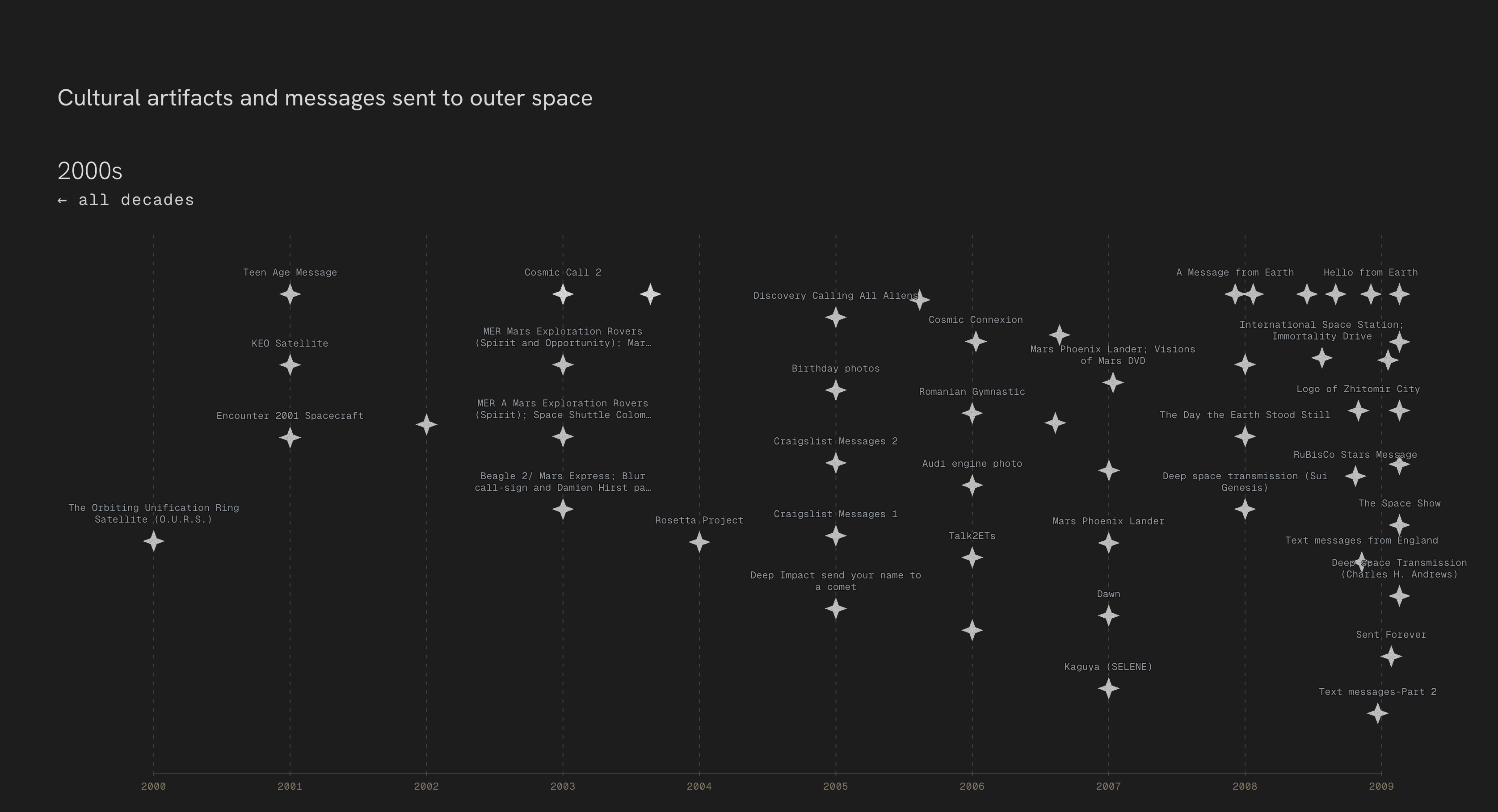
The Talking to Space layer draws on a curated catalogue of cultural objects and messages sent beyond Earth, based on Paul E. Quast's "A Profile of Humanity: The Cultural Signature of Earth's Inhabitants Beyond the Atmosphere," in Speaking Beyond Earth: Perspectives on Messaging Across Deep Space and Cosmic Time (2024).
The first layer analyzes how outer space has been discussed in public language, tracing how dominant themes and actors shift across news coverage and political rhetoric over seven decades.
The second layer shifts from language about space to messages sent into it, tracing how cultural artifacts—from institutional messages to more distributed and commercial initiatives—reflect changing ideas about who speaks for humanity and what is said in its name.
Across both layers, outer space is not only explored but continuously constructed: the way it is described in media and politics, and the messages sent beyond Earth, reflect a changing field of meaning shaped by institutions, technologies, and competing visions of the future.