← All work
Parsons × Netflix: Film, Culture, and Classification

Anatomy of a Horror Hit

Horror films are a cultural barometer: capturing, distorting, and projecting collective fears back to us. Using Netflix’s Engagement Report for January to June 2025, this project examines what the platform’s most-watched horror titles reveal about the anxieties shaping contemporary popular culture.

Prototype
Role
Concept, data analysis, classification design, and development
Context
Parsons × Netflix partnership
Data
Netflix Engagement Report (Jan–Jun 2025), OMDb API, IMDb data, TMDB API
The Challenge

Netflix’s Engagement Report (Jan–Jun 2025) captures aggregate viewing across all genres on the platform. The challenge was to move beyond this broad distribution and surface more specific, interpretable patterns within it: not just what is watched, but what kinds of narratives and themes dominate attention.

The horror genre serves as a focused entry point for this analysis. From a cultural perspective, it translates diffuse tensions and anxieties into recognizable narrative forms, making it particularly suited for structured analysis. From an industry perspective, horror has grown from a niche genre into one of the most commercially significant categories in contemporary film, accounting for a record 17% of North American ticket sales in 2025.

The Concept

The project approaches horror as a cultural barometer, treating a large set of popular titles as a corpus through which contemporary fears can be mapped, compared, and grouped.

At its core is a classification system that assigns each film a primary fear category, allowing the analysis to move from individual titles to a broader structure of recurring themes.

The Process

Film metadata was compiled from Netflix’s Engagement Report and enriched through OMDb, IMDb, and TMDB. Each title was then classified by core fear using a hybrid workflow: a local LLaMA-3 8B model run via Ollama, prompted with the film’s title, synopsis, and keywords, and guided by a manually designed taxonomy.

Model outputs were then manually reviewed and refined. Categories were consolidated into three higher-order supergroups reflecting broader dimensions of recurring fears.

The Visualization

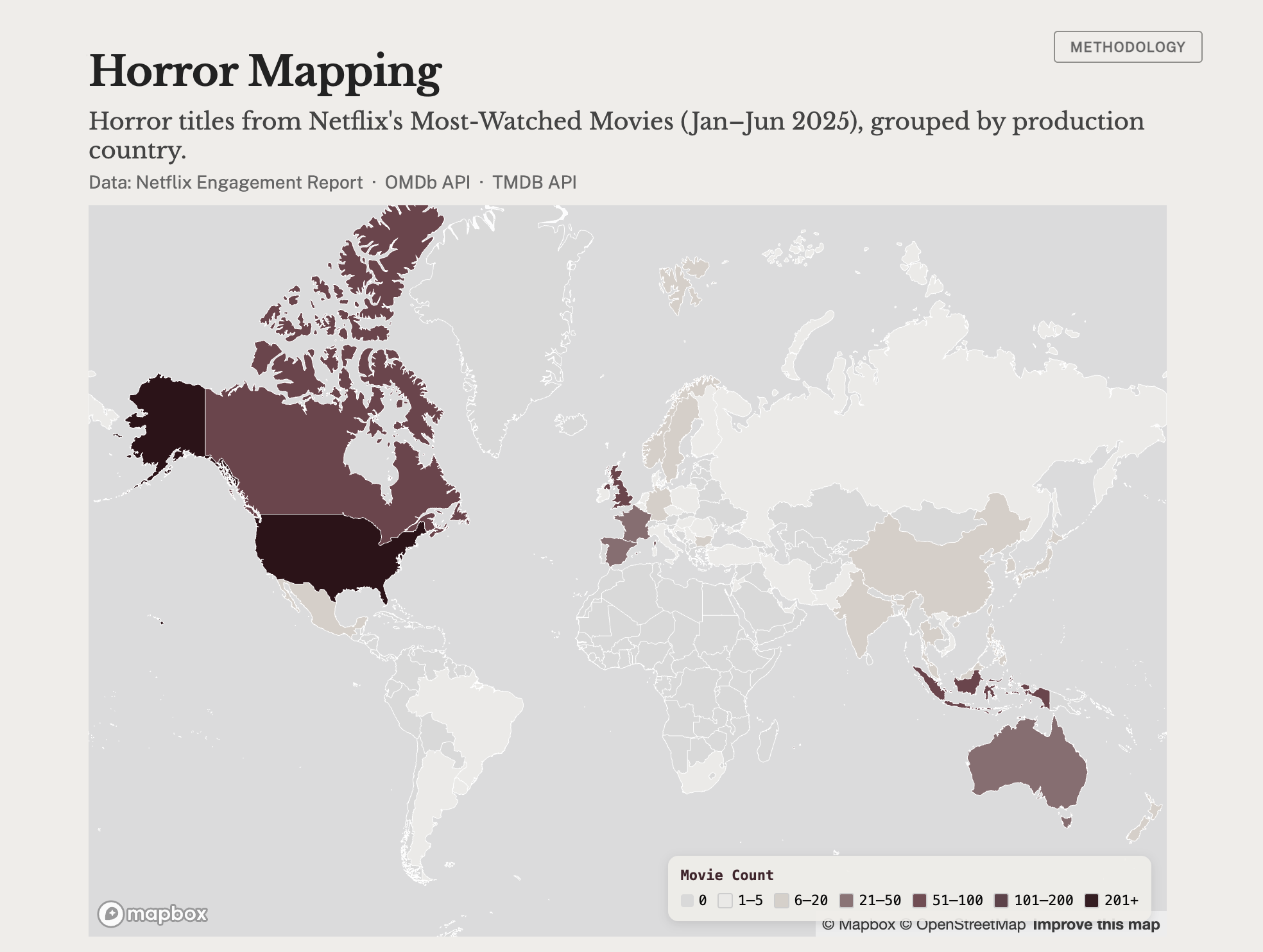
The project opens with a hit matrix comparing all genres by total views and IMDb rating, situating horror within a larger field of popular film consumption. It then narrows to horror itself, showing which fear categories dominate the genre, which patterns recur across subgroups, and how titles are distributed geographically.
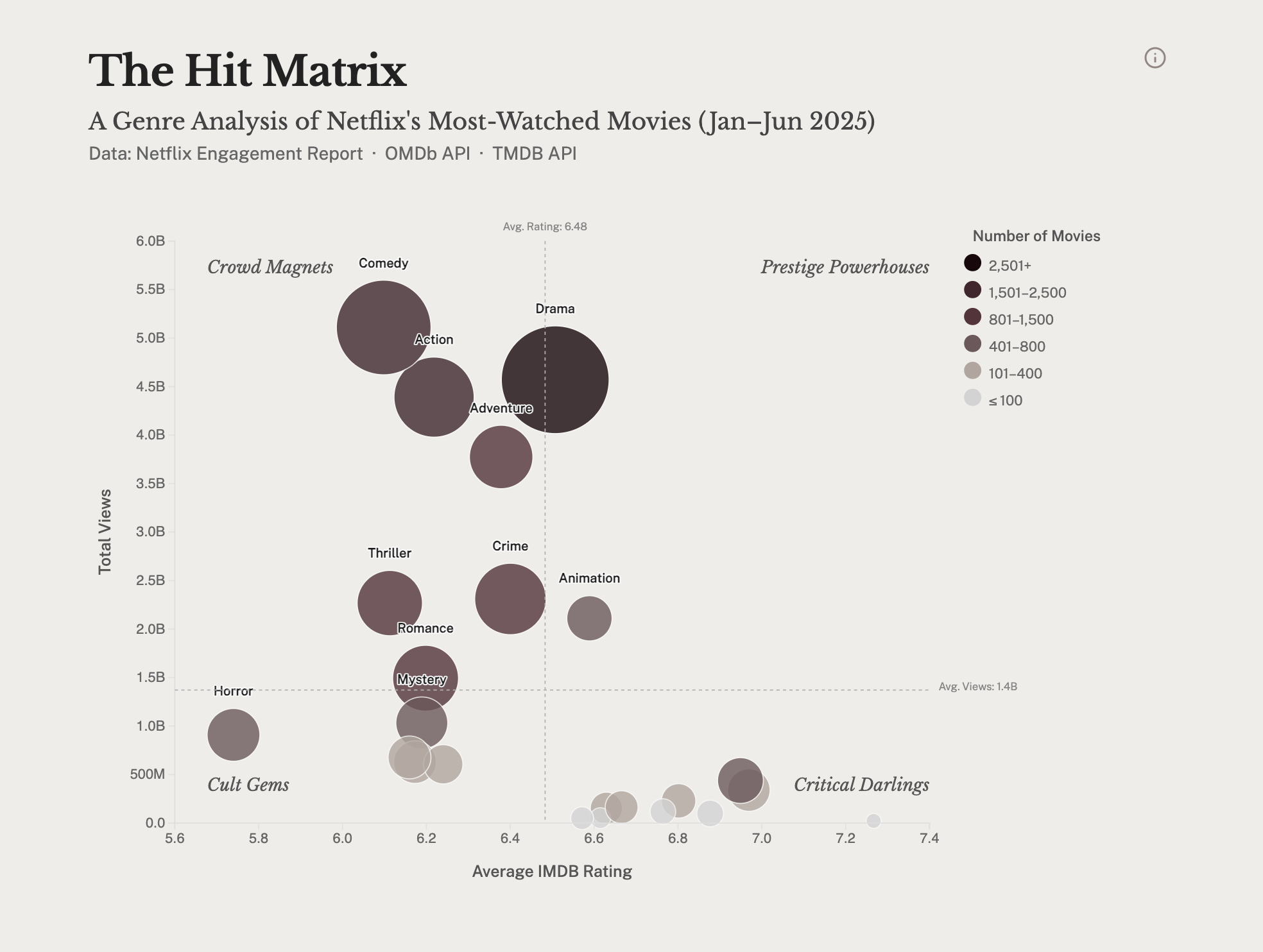
Genre comparison matrix of Netflix's most-watched films
Genre comparison matrix plotting popularity against critical reception
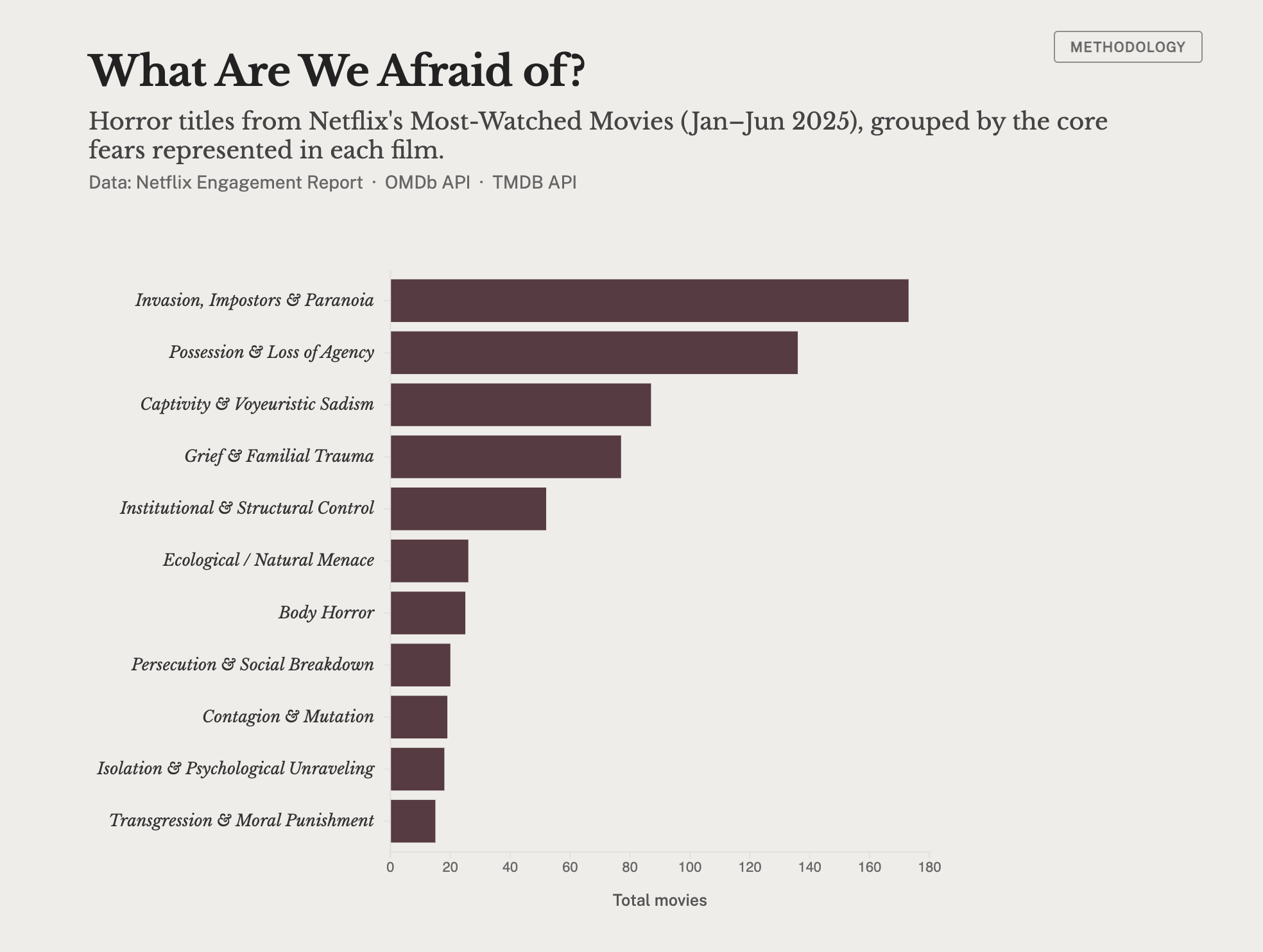
Distribution of horror titles by core fear
Distribution of horror titles by core fear category
Geographic distribution of horror film production countries
Geographic distribution of horror titles by production country
Prototype
← All work